


A Deep Dive into Branching Conversations, Editable Prompts, and the Future of Terminal AI
🧨 1. A Surprising Truth About Terminal AI in 2025 — A Surprising Truth in 2025
Here’s the part almost nobody realizes — and even fewer talk about:
Every major AI coding tool can write code, refactor, test, debug, and explain…
…but only one tool on Earth lets you fix a previous prompt and restart the conversation from that point.
Not Gemini CLI. Not Codex CLI. Not Copilot CLI. Not even the local LLM community.
❗ Only Claude Code supports true conversation editing + branching in the terminal
This is wild. We’re in 2025. We have:
- GPT‑5.1 Codex Max writing entire services
- Gemini 3 Pro V generation flowing from laptop to cloud
- Llama 3.2 running fully offline
- Cursor and VSCode agents rewriting codebases
Yet the terminal — where real builders live, automate, and ship — still behaves like it’s 1994.
Except one tool.
This post explains the real reason why branching conversations are the missing superpower in CLI AI… and how we bring this future into existence.
And yes — I’m writing this from the lens of a solo founder building with AI as my co‑founder, inside my PreAngel + Ship.Fail system. Because terminal agents are becoming our creative partners, execution engines, and reasoning amplifiers — not autocomplete boxes.
Let’s dive in — and map out the future.
🚧 2. The Real Problem: Terminal Agents Are Still Linear
Imagine this:
You’re deep in a coding session. Claude/Gemini/Codex rewrote half your project. But then you realize — wow — your third prompt was wrong.
Now everything downstream is compromised — polluted context, broken edits, and tangled reasoning.
You want to go back, fix prompt #3, and regenerate the entire flow.
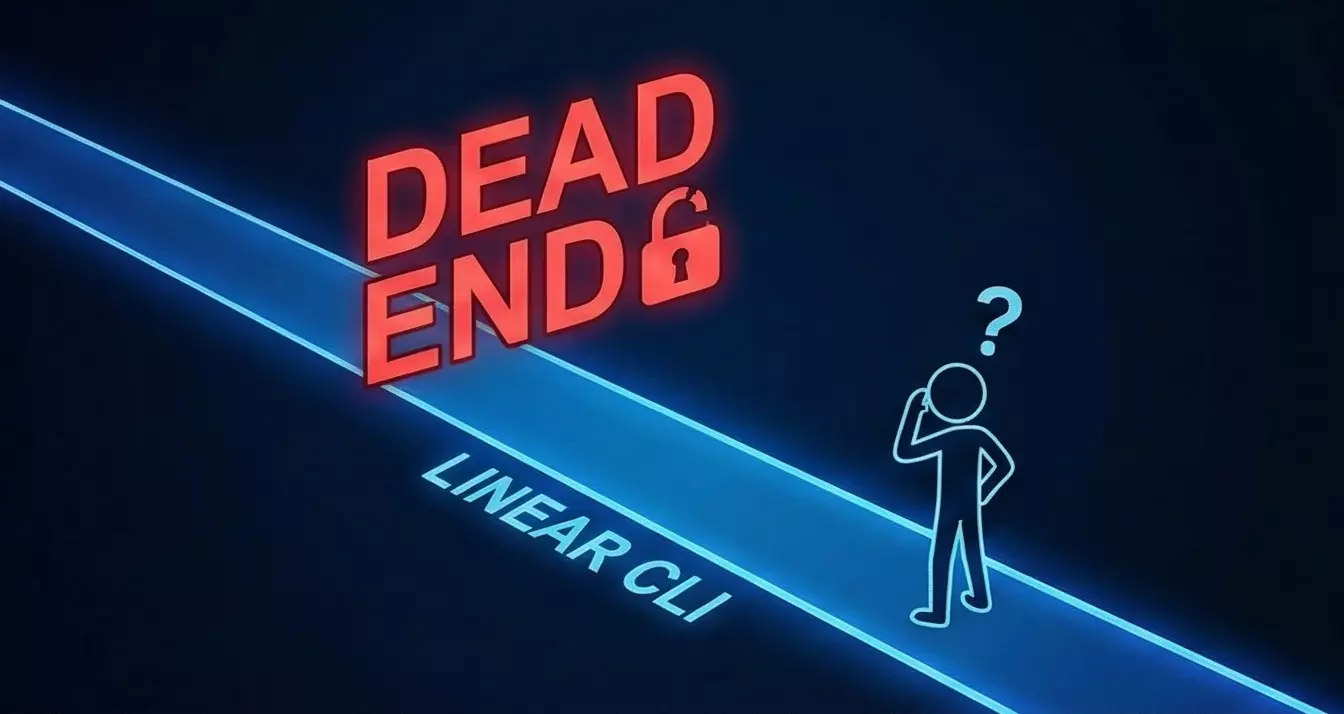
In every CLI except Claude Code
- you cannot edit prompt #3
- you cannot restart from that point
- you cannot drop later conversation nodes
- you cannot rollback the filesystem changes
- you cannot branch your session
In every CLI today, your only option is:
/reset
…and lose everything.
You feel this pain because real engineering workflows are iterative, not linear. Coding is not chat. Coding — especially with an AI co-founder — is:
- refine → test → revert → branch → repeat
But CLIs treat coding like SMS texting.
🔍 3. The Reality Check — Full Market Scan (2025 Updated)
Below is the latest and factual state of every major CLI coding agent.
🟢 Claude Code 2.0 (Nov 2025)
The only CLI with:
- ESC ESC history navigator
- editable previous prompts
- conversation tree branching
- workspace-aware context
- session persistence
- rollback-safe file operations
Claude Code behaves like a tiny IDE inside the terminal.
It is the only agent treating the terminal as a first‑class environment.
🟡 Gemini CLI (GemNet) v1.x (2025)
Powerful model. Great performance. But:
Missing:
- no editing previous prompts
- no checkpoint/restore
- no rewind
- no tree navigation
- no branching
Developers complain loudly:
“Once a prompt is wrong, everything after is ruined.” – GitHub Issue #10530
Another plea:
“We need conversational checkpoints.” – Issue #14105
🔵 OpenAI Codex CLI (GPT‑5.1 Codex Max)
Incredible model. Handles huge repos. But the CLI:
- is stateless
- no branching
- no editing
- no history UI
- built mainly for automation + cloud workspaces
As one dev said:
“Codex is smart, but the CLI feels like ChatGPT 2022.”
🟣 GitHub Copilot CLI
Designed for terminal commands, not full conversations.
Missing:
- branching
- editing
- undo
- timeline view
Great for git and shell automation. Not for deep code sessions.
⚫ Local LLM CLIs (Ollama, llama.cpp)
Fantastic for offline coding. But:
- no branching
- no history editing
- no structured state
Every REPL is still 1-dimensional.
📣 4. Developer Voices — The Community Already Knows
This isn’t just my opinion. Developers across the internet are shouting the same thing.
Here are real, public conversations:
🗣️ Hacker News
“Gemini CLI makes the models look dumb. Claude Code floors me every time.” https://news.ycombinator.com/item?id=44376919
🗣️ Reddit (Gemini)
“Why can’t we edit older messages? It makes Gemini unusable for debugging.” https://www.reddit.com/r/GoogleGeminiAI/comments/1jmheul/why_cant_we_edit_previous_messages_frustrating
🗣️ Gemini CLI Feature Requests
“We need to edit old prompts and revert all subsequent steps.” https://github.com/google-gemini/gemini-cli/issues/10530
“Please implement /checkpoint and /restore.” https://github.com/google-gemini/gemini-cli/issues/14105
🗣️ Developer Blog
“Claude Code is usable. Gemini CLI is powerful but linear. Codex CLI is intelligent but not interactive.” https://blog.metamirror.io/claude-code-v-gemini-cli-e144feafbcf2
🗣️ Medium Benchmark
“I tested 5 CLI agents — only Claude Code feels complete.” https://medium.com/lets-code-future/i-tested-5-cli-coding-agents-heres-what-actually-surprised-me-c0d2fbd421ec
🗣️ LinkedIn Dev Opinion
“Claude Code lets me fix and re-run. Others force a full reset.” https://www.linkedin.com/posts/matt-koppenheffer_quick-thoughts-on-cli-coding-agents-since-activity-7372353748645363713-wfQ1
The industry is already speaking. Loudly.
🧠 5. Why Only Claude Code Supports Branching
This is the pivotal section — the part that explains the industry gap everyone feels but nobody articulates.
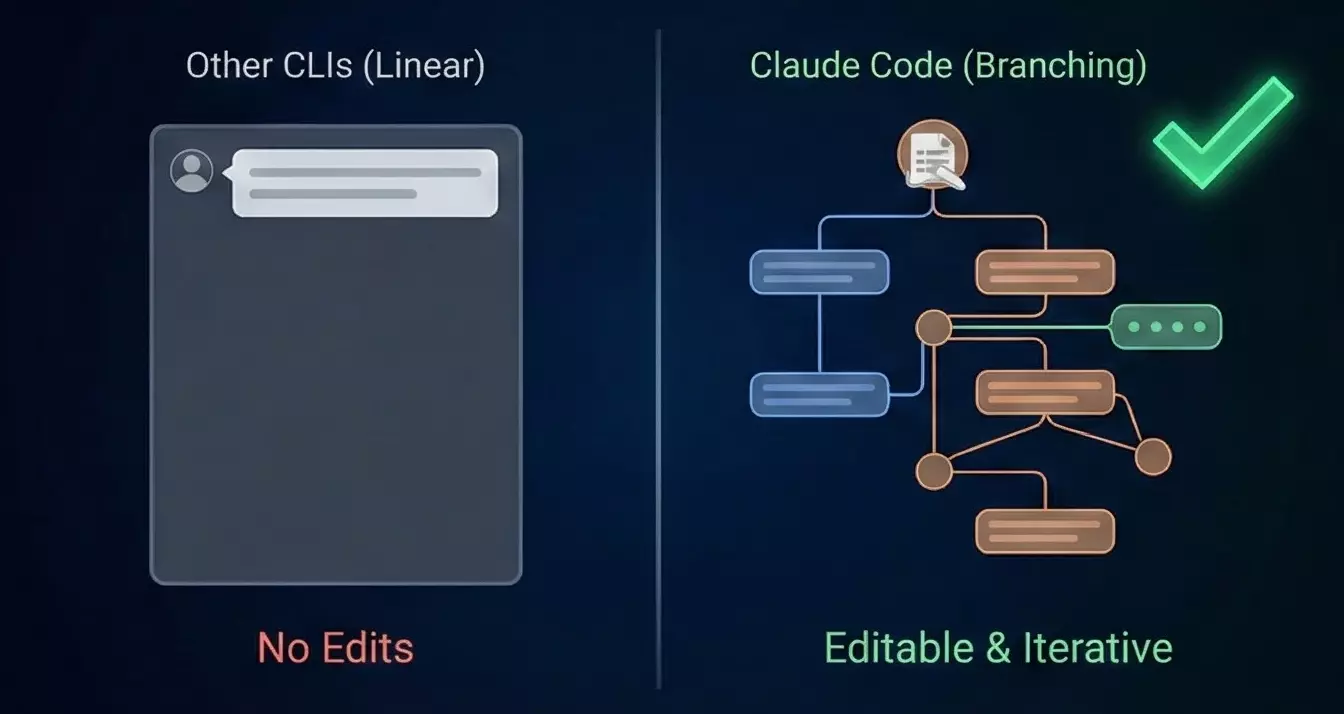
Here’s the real reason:
5.1 Strategic Reason
Anthropic’s philosophy: help developers iterate, not just generate.
Everyone else:
- Google → scripting & automation
- OpenAI → cloud agents + IDE
- GitHub → command assistants
- Local LLMs → inference layers
Only Claude Code targets terminal-native iterative programming.
5.2 Technical Reason
Implementing branching requires:
- timeline tracking
- TUI navigation interface
- workspace versioning
- undo/redo semantics
- conversation state manager
- replay engine
- side-effect rollback
This is basically: Git + Jupyter + LLM, inside a CLI.
Nobody else built this layer.
5.3 UX Reason
Terminal UX is hard.
Claude Code’s ESC‑ESC interface is effectively a UI framework embedded in a terminal.
Others treat terminal like raw stdin/stdout.
5.4 Product Reason
Every company made tradeoffs.
Claude Code: build a
first-class AI IDE inside the terminal.
Competitors, meanwhile, made different tradeoffs:
- Copilot CLI → shell shortcuts
- Gemini CLI → thin model wrapper
- Codex CLI → cloud service front-end
- Local CLIs → minimal REPLs
Different priorities → different capabilities.
🚀 6. Design Proposal — What a Real 2026+ Terminal AI Should Deliver
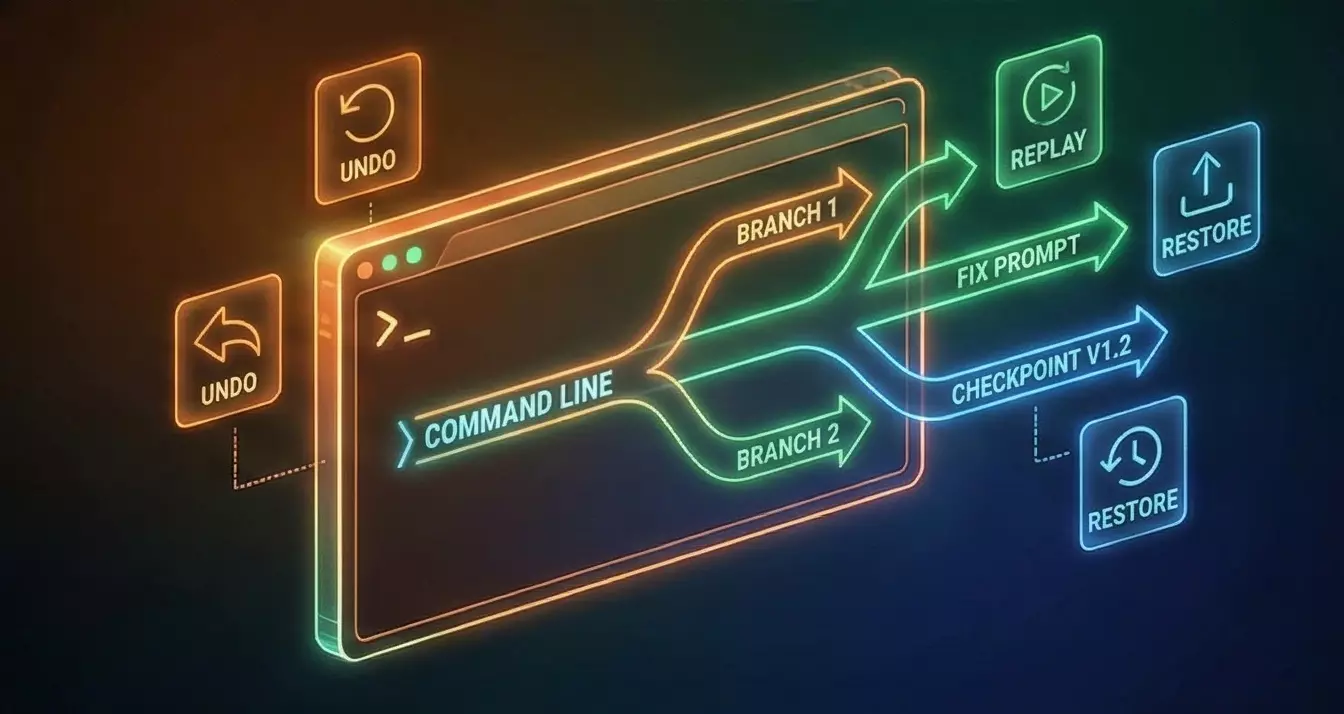
If we were to design the next-generation terminal agent, it must include:
✔ 1. Conversation Tree View
Side-branching like Git. Editable nodes. Time-travel debug.
✔ 2. Prompt Editing
Fix prompt #3 and regenerate everything after.
✔ 3. Checkpoint / Restore
/checkpoint v1.2
/restore v1.2
✔ 4. Full Workspace Diffing
Before applying massive changes, show diffs.
✔ 5. Undo/Redo for File Operations
LLM‑safe filesystem.
✔ 6. Replay Mode
Let the agent re-simulate prior decisions.
✔ 7. Agent Reasoning Mode
Watch the agent reason step-by-step.
✔ 8. Offline + Cloud Sync
Local speed, cloud intelligence.
This isn’t sci-fi — this is the logical next step in AI-native engineering. This is the standard I want as a solo founder building with AI co-founders — and the standard our ecosystem deserves.
🔮 7. The Forecast — Where CLI Agents Are Headed (2026–2027)
Here’s where the industry will go.
Prediction 1 — Google will adopt branching first.
The demand is too loud.
Prediction 2 — OpenAI will build a “Codex IDE mode” inside the CLI.
Codex Max is too powerful to stay linear.
Prediction 3 — Copilot CLI will remain automation-first, not conversation-first.
GitHub’s strength is workflow, not dialog engines.
Prediction 4 — Developers will demand a “CLI Notebook Experience.”
Notebook → IDE → Terminal Notebook Agent.
Prediction 5 — Local LLMs will eventually adopt a minimal branching UI.
Open-source devs are hungry.
And when this shift happens, Claude Code will be seen as the tool that started it.
💡 8. Developer Experience Manifesto — A New Standard for Terminal AI
Here’s my proposal for the industry.
A terminal AI agent must be iterative, rewindable, branchable, debuggable, and stateful.
Linear REPLs are no longer acceptable for real engineering.
Conversation editing is not a luxury — it is a foundational requirement.
Every CLI agent needs branching, checkpoints, undo/redo, and file-safe execution.
This is the future I want — for myself, for PreAngel founders, and for every builder creating AI-native companies.
🔚 9. Conclusion — The Future of Terminal AI Depends on This One Feature
The models are powerful. The ideas are endless. The future of building with AI will happen in the terminal.
But unless our CLI tools support:
- conversation editing
- branching
- rewind
- replay
- undo
…we are stuck in linear workflows that break as soon as one prompt goes wrong.
Claude Code shows what’s possible. It sets the bar.
Now it’s time for the industry to catch up.
 The Vibe Coding Cloud Protocol: One Tree to Rule Your Infrastructure